



In 2025, dramatic cuts to global health financing, including the USAID shutdown, have prompted a wave of articles seeking to “reimagine” global development and global health. Our contribution to this literature expands on our existing proposal—the New Compact for health financing between donors and recipient countries (see Box 1). To date, we have considered the New Compact from the perspective of a recipient country (Ethiopia) and of a single global health initiative (Gavi). In light of the rapidly evolving context, we now consider the perspective of “upstream” donors. In a model where recipient countries are setting priorities that donors align with – what decisions must donors still make?
We argue that by moving beyond priority-setting by diseases and interventions, donors can instead focus on how best to prioritise common goods and country partnerships. That is, they can embrace their comparative advantage to provide important shared resources that would otherwise be neglected by national health institutions, perhaps by adopting a radical simplification approach to maximise chances of success for the most promising goals. They can also continue to support countries to deliver the most essential health services and strengthen their healthcare systems while they do it. By moving away from earmarked funding for specific conditions or technologies, donors could instead prioritise according to which country partnerships are likely to yield the best outcomes. This country prioritisation will in part be pragmatic and political—yet even so, there are opportunities for considering how we unify the instinct to value health equally in all countries with the need to prioritise effectively in the face of scarce resources.
A New Compact for health financing does not mean the end of donor priority setting; it means prioritising along the right dimensions and finding new ways to do so.
Box 1. The New Compact for Global Health Financing
The New Compact is a proposed framework to reform global health financing and address persistent challenges in the current aid system, including funding volatility, fragmentation, and limited country ownership. At its core, the New Compact seeks to rebalance the relationship between donor countries and aid recipients by centering three pillars:
- Locally led, evidence-informed priority-setting: Recipient countries, with technical support as needed, determine their own health priorities based on evidence.
- Domestic-first resource allocation: Countries commit to financing their highest-priority, essential health services from domestic budgets, reducing reliance on unpredictable external aid for core services.
- Consolidated supplementary aid: Donor funding is used to expand the package of services beyond what domestic resources can cover, focusing on supplementary and cross-cutting needs rather than duplicating or displacing domestic spending.
This approach aims to reduce burdensome fragmentation in external financing, enhance funding security for essential services, and yield greater health impact per dollar spent for both domestic and donor funds. It also empowers national institutions while creating a natural donor exit strategy, as domestic financing expands to crowd out external financing over time.
Donor priority setting today: Diseases and interventions
Current donor approaches to global health priority setting tend to focus on diseases and interventions. In some ways, this is sensible: donors are prioritizing based on (i) the problem and (ii) the solutions. The criteria and mechanisms for this prioritisation can be technical and sometimes highly complex, factoring in disease burden, expected health impact, cost-effectiveness, equity and so on. In other cases, priorities can be more pragmatic or political, driven either, for example, by a particularly effective advocacy group or by decision-makers’ instincts and incentives.
An implicit assumption to donor priority-setting today, or at least in recent decades, is that even where public healthcare systems exist, service coverage will be limited. As a result, donors have often opted to independently identify which diseases or interventions to support, aiming to maximise rollout of their chosen priorities. Donor attempts to plug these coverage “gaps” can achieve short-term health gains—yet such an approach may not be the best way to build effective local healthcare systems. Earmarked external financing can undermine the social compact between national institutions and communities, displace domestic resources, sidestep public financial management systems, and leave essential services vulnerable when donor funding proves unreliable, as repeatedly demonstrated by aid cuts and abrupt programme closures.
In many cases, disease and intervention priorities – and a plug-the-gaps approach - are baked into the mandates of bilateral programmes, civil society organisations and multilateral initiatives - with the Global Fund Against HIV/AIDS, TB and Malaria and Gavi, the most prominent. Over recent decades, the number of such initiatives, organisations and financing flows has proliferated, increasing burdensome complexity for recipient countries; this can in turn distract officials from the business of health system administration and undermine local priority-setting processes.
The focus on diseases and interventions means cross-country prioritisation – choosing which countries to work with – often takes a back seat. Cross-country prioritisation may be managed via eligibility criteria (e.g. for a multilateral initiative); decided by mid-level officials (e.g. those charged with development of a business case to address a particular disease or intervention); or occur as a de facto result of where certain organisations have existing in-country offices. It is relatively rare that such decisions are subject to explicit estimates of impact and opportunity cost.
Donor priority setting tomorrow: Common goods and country partnerships
We consider two alternative domains within which donors could focus their priority-setting: common goods and country partnerships.1
Common goods
Common goods for health include global public goods, such as openly accessible health information and guidance, or a shared freedom from eradicated diseases. Public goods must be non-rivalrous (one person’s ability to benefit does not affect another’s) and non-excludable (you cannot choose to provide this to some people and not others). Some health initiatives have a shared benefit – so are common goods – but do not meet the condition for being a public good. Examples here include the development of new health technologies or effective systems to trade health commodities.
There is a clear role for international donor financing of common goods, including those generated at the country level (e.g. disease surveillance). In many cases, common goods will be systematically undersupplied by the sum of priorities from individual countries; this is the “collective action problem” well established in economic theory. Therefore, intentional international cooperation and private philanthropic support is well placed to ensure common goods are created and sustained. Yet donors must still prioritize among common goods. Here, evidence-informed radical simplification may both maximise the chance of impact and facilitate more effective communication with stakeholders.
Country partnerships
It would be a mistake for global health financing to focus exclusively on common goods and in turn withdraw from financing country-level health services. Even with increased domestic health financing, many countries will still rely on external financing to deliver essential health services. Donor support to these countries must be sustained to avoid people dying of conditions that can be avoided or treated for astonishingly small amounts of money. We should not accept that extraordinarily effective and cost-effective services are still not available to all, and global health reforms should not seek to overturn the current paradigm’s focus on equitable access to lifesaving care.
However, realising the potential of health technologies for the long run requires financing not only for service delivery but also capital investments and cross-cutting support for healthcare platforms and networks. Moreover, there is increasing recognition that donors must radically reduce the extent to which they dictate the focus of healthcare services in recipient countries and of the limitations of global prioritisation evidence in determining what is cost-effective at the country level. This is reflected in the resurgent interest in donor coordination and country-lead prioritization initiatives, including such as Sector Wide Approach (SWAp) platforms, the Lusaka Agenda, the recent World Health Assembly resolution on health financing, and our own proposal for a New Compact for health financing.
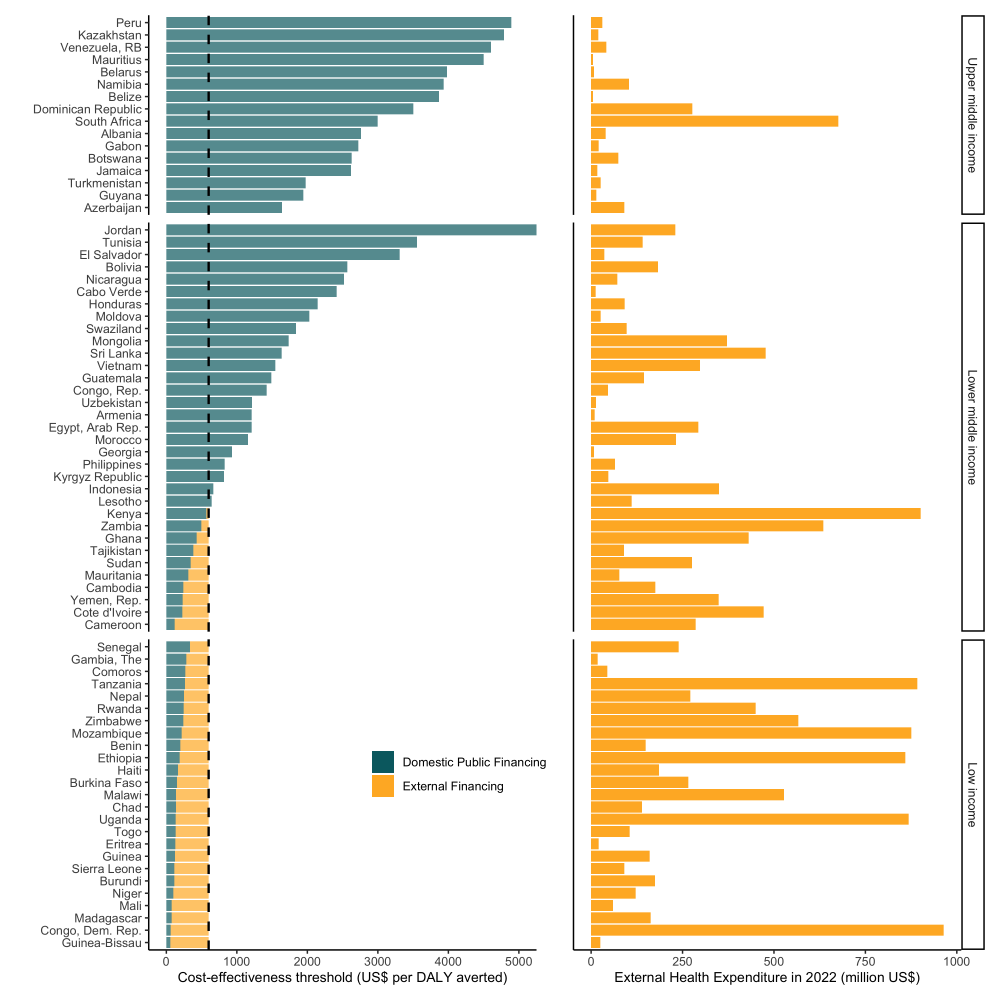
Even if recipient countries are to be the ones setting domestic priorities for health service delivery, donors can still meaningfully prioritise across countries. To illustrate, let’s assume donor interest is in health maximisation and/or health equity, rather than transactional or pragmatic factors. We can also see “health maximisation” as shorthand for prioritising health and other things of value. Figure 1 illustrates a well prioritised health services package with domestic-first financing and consolidated supplementary aid – in other words, the idealised “New Compact” model. Figure 2 illustrates how this model plays out across multiple countries. In Panel A, each bar represents a country health services package, i.e. as illustrated in Figure 1. Interventions are not directly represented but the bar segments correspond to a package of services. Note that the height of the bar does not reflect volume of financing but the cost-effectiveness of the least cost-effective service funded. In this model, if donors sequentially choose the next most health maximising opportunity until their collective budgets are exhausted, we obtain a distribution that broadly prioritises poorer countries where marginal opportunities to buy health will tend to result in more health for the money. Figure 2 Panel B presents the distribution of external financing for health in 2022.
Figure 1. Illustrative country-level health services financing

* Each bar is a health service or intervention, the height is its cost-effectiveness, and the width is its cost.
Figure 2. Illustrative multi-country health services financing
Please click the image to enlarge.
* Panel A: Each bar is a country health services package, the length is the cost-effectiveness of the least cost-effective service funded. Panel B: Each bar is the total health expenditure from external sources in 2022 according to the WHO Global Health Expenditure Database.
Note that the donor allocations imply a common standard threshold across all countries. This donor cost-effectiveness threshold or minimum DALY value is analogous to country level healthcare priority-setting and could potentially be a mechanism to guide donor decision making. There are different schools of thought on whether explicit or notional cost-effectiveness thresholds are more effective, and different high-income countries have taken different approaches. If donors were to adopt a consistent threshold – say by a WHA resolution that any service that delivers health for say $150 per DALY should be funded – then country-level donor coordination group can consider the evidence on whether such services exist in the country and are genuinely unaffordable to the government. In a sense, this returns us to the early proposals for priority-setting by the seminal 1993 World Development report, but crucially incorporates the role of the recipient country ministry of health as the primary decider and funder. A minimum DALY value also bridges normative ambitions to value health and life equally in all countries with more hard-nosed approaches to the reality (and importance) of priority setting in the context of scarce resources. In this approach, it is specifically the equal valuing of health in all countries that drives effective prioritisation.
A dose of reality
The strategic shift outlined above is, as with the high-level description of the New Compact for health financing, a simplification. A transition of the frameworks for donor prioritisation from diseases and interventions towards common goods and country partnerships would entail many real-world considerations not fully developed here.
Evidence informed priority-setting of common goods can be far more challenging than for healthcare services. It often requires dealing with hypotheticals for the creation of products that do not yet exist, as well as significant uncertainty in whether investment will be successful. However, in some cases there are tools available to specifically address these kinds of risk such as Advance Market Commitments. While uncertainty in outcomes for investing in common goods cannot always be avoided, many philanthropic donors are explicit about their appetite for giving under uncertainty, even if state donors tend to be more risk averse.
Similarly, decisions to allocate development assistance for health to countries will not be the result of a simple impact estimation model. Donors support recipient countries for a complex mix of reasons including historical ties, personal or national values, and transactional opportunities. Morever, there are multiple global health donors, and harmonising funding and aligning behind country priorities will require significant shifts to donors’ ways of working. At times recipient country priorities will differ from those of donors; donors may nevertheless wish to some targeted external support to marginalized groups even as most funds flow through a New Compact-like structure. There is neither a mature methodology nor a robust evidence base yet available for quantitative analysis to inform priority setting of country partnerships. However, donors can nevertheless use a mixture of high-level heuristics, politics, and pragmatics for strategic prioritisation, combined with participation in country level SWAp-like coordination platforms.
While there are challenges, a focus on prioritisation of common goods and country partnerships is a better fit for the appropriate role of global health donors and will do a better job of supporting recipient countries.
Recommendations
- Recipient countries should call on donors to help reform global health financing to better support their national processes and align behind the resulting priorities.
- Global health funders should identify countries to partner with to pilot a new compact approach and consider policy reforms necessary to adapt to these new ways of working.
- Development research funders should develop a programme of academic and think tank work to explore and advance methods for a new era of donor priority-setting.
Thanks to Anastassia Demeshko for support with edits to the figures.
1 This shift might also align with potential reforms to official development assistance (ODA), with some leaders calling for a clearer distinction to be made between different kinds of ODA and differentiated financing mechanisms.
Topics
CITATION
Drake, Tom, Jessica Ochalek, Witold Więcek, Nadia Yakhelef, and Rachel Bonnifield. 2025. A New Compact for Health Financing: Donor Priority Setting. Center for Global Development.DISCLAIMER & PERMISSIONS
CGD's publications reflect the views of the authors, drawing on prior research and experience in their areas of expertise. CGD is a nonpartisan, independent organization and does not take institutional positions. You may use and disseminate CGD's publications under these conditions.
Thumbnail image by: vetre/ Adobe Stock