

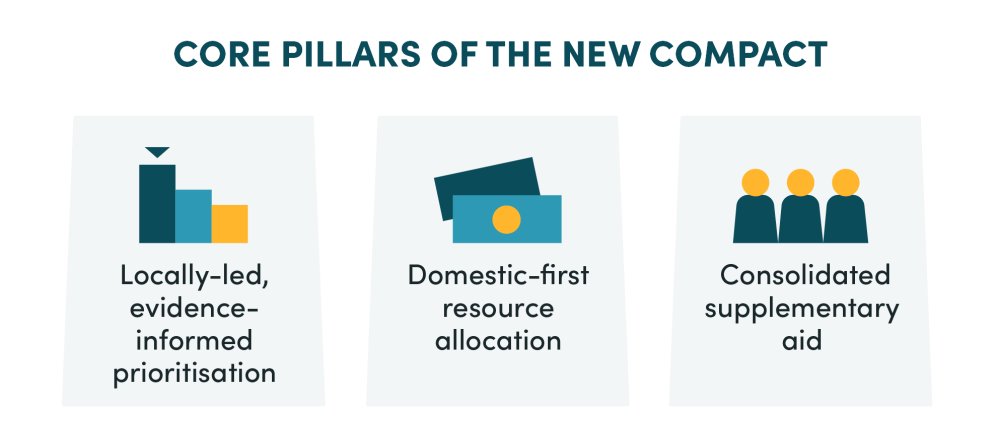
Core Pillars of the New Impact
Learn More About the New Compact
For countries to benefit from more effective health aid, financing models must be designed to support long-term resilience rather than short-term project cycles. National evidence-informed priority-setting is a key way by which this can be achieved.
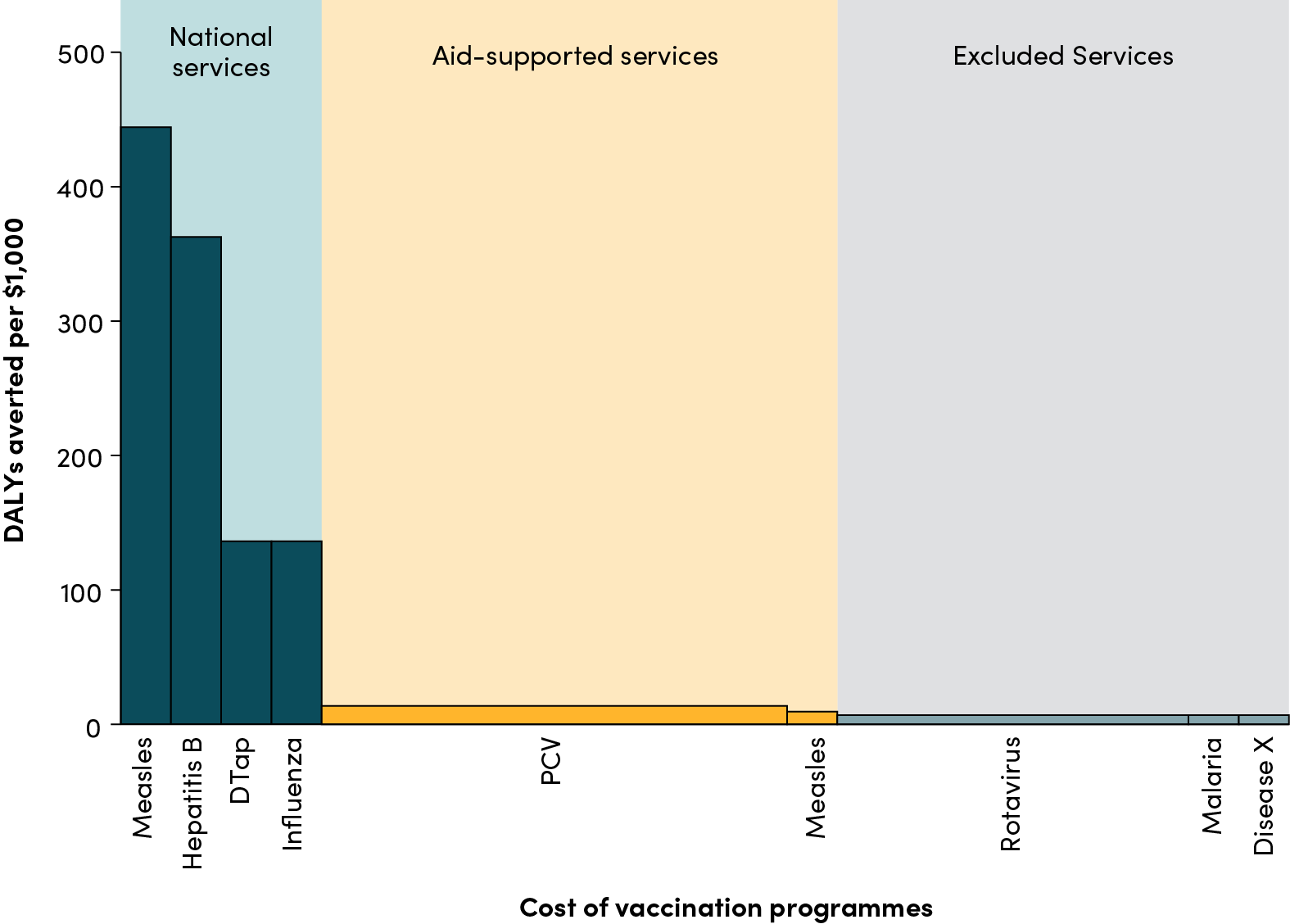
Expanding on this in the figure below, each bar in the image represents a health service—the height is the health benefit per dollar and the width is cost. By making more cost-effective decisions, we can get more health for the money. But aid often targets high-value services, disrupting country financing.

An alternative approach could be for countries to take ownership of high-value services while donors focus on funding an additional ‘top-up package’ of services at the margin (or other cross-cutting investments). This would allow countries to manage a core package of health services that naturally crowds out aid as domestic budgets grow. Read more on what this might look like for countries:
Reimagining Global Health Financing: How Refocusing Health Aid at the Margin Could Strengthen Health Systems and Futureproof Aid Financial Flows – outlining how global health aid can be more strategic, sustainable, and responsive to country needs.
- A New Compact for Health Financing: Insights from Policymakers Across Africa - summarising perspectives from African policymakers on how a New Compact could address key financing challenges.
- A New Compact for Financing Health Services in Ethiopia - presenting a potential New Compact model for Ethiopia, outlining how it could reshape financing structures to improve sustainability and health outcomes.
- A New Compact for Health Aid: Integrating Evidence-Informed Priority-Setting and Public Financial Management - examining how better financial governance and decision-making can improve aid effectiveness.
While much of the New Compact work focuses on country-level coordination, we can also consider how donor organisations could adapt their policies and practices. We look both at what some of the challenges could be but also the opportunities to donors for such shifts.
- A New Compact for Financing Health Services: Opportunities for Gavi and Partner Countries - analysing how Gavi could adapt its funding model to better align with country-led priorities and long-term system strengthening.

- Achieving Value for Money in Global Development: Six Recommendations for the FCDO - outlining practical steps for the FCDO to enhance the impact and efficiency of its global health investments.
- A New Compact for Health Financing: Donor Priority Setting – how donors can prioritise effectively by focusing on common goods and country partnerships instead of diseases and interventions.
Global health aid is often fragmented, unpredictable, and misaligned with country needs, making it difficult for governments to plan and sustain essential health services. The New Compact for Health Financing proposes a shift towards more reliable, flexible, and country-led funding models that strengthen health systems and future-proof financial flows.
- Reimagining Global Health Financing: How Refocusing Health Aid at the Margin Could Strengthen Health Systems and Futureproof Aid Financial Flows – outlining how global health aid can be more strategic, sustainable, and responsive to country needs.
- Decoupling “Stop Work” Orders from “Stop Basic Care”: How New Aid Models Can Protect Countries from Unreliable External Financing – examining the risks of volatile aid funding, such as that of USAID in 2025, and proposing mechanisms to prevent service disruptions.
The New Compact reforms sit within a wider global health and development system; financing health services is only part of the story. In the links below we discuss the broader political economy, the link with financing of common goods and the implications of the USAID shutdown.
- Putting Aid in Its Place: Financing Common Goods - on how aid should be restructured to support global and regional public goods in health.
- A New Compact for Health Financing: The Global Political Economy of Reform - analysing the political and economic factors shaping health aid reforms.
- Decoupling “Stop Work” Orders from “Stop Basic Care”: How New Aid Models Can Protect Countries from Unreliable External Financing – examining the risks of volatile aid funding, such as that of USAID in 2025, and proposing mechanisms to prevent service disruptions.
External Contributors:
Alec Morton, Professor of Management Science, Saw Swee Hock School of Public Health, National University of Singapore; Strathclyde Business School, University of Strathclyde
Amanuel Haileselassie, Senior Advisor for Health Financing, Amref Health Africa
Catherine Pitt, Professor of Health Economics, London School of Hygiene and Tropical Medicine
Jamaica Briones, Research Associate, Saw Swee Hock School of Public Health, National University of Singapore
Javier Guzman, Division Chief, Health, Nutrition and Population, Inter-American Development Bank
Mishal Khan, Professor of Global Public Health, London School of Hygiene and Tropical Medicine
Mizan Habtemichael, Research Coordinator, Addis Center for Ethics and Priority Setting
Nadia Yakhelef, Head of Health Economics and Financing, Africa Centers for Disease Control
Ole F. Norheim, Mary B. Saltonstall Professor of Ethics and Population Health, Global Health and Population, Harvard T.H. Chan School of Public Health
Solomon Tessema Memirie, Professor, Addis Center for Ethics and Priority Setting, Addis Ababa University
Tesfaye Mesele, Strategic Affairs Officer, Federal Ministry of Health, Ethiopia
Y-Ling Chi, Senior Health Economist, UK Health Security Agency
CGD Staff:
Adrian Gheorghe, Policy Fellow
Anastassia Demeshko, Research Assistant
Pete Baker, Policy Fellow and Deputy Director of Global Health PolicyTom Drake, Senior Policy Analyst