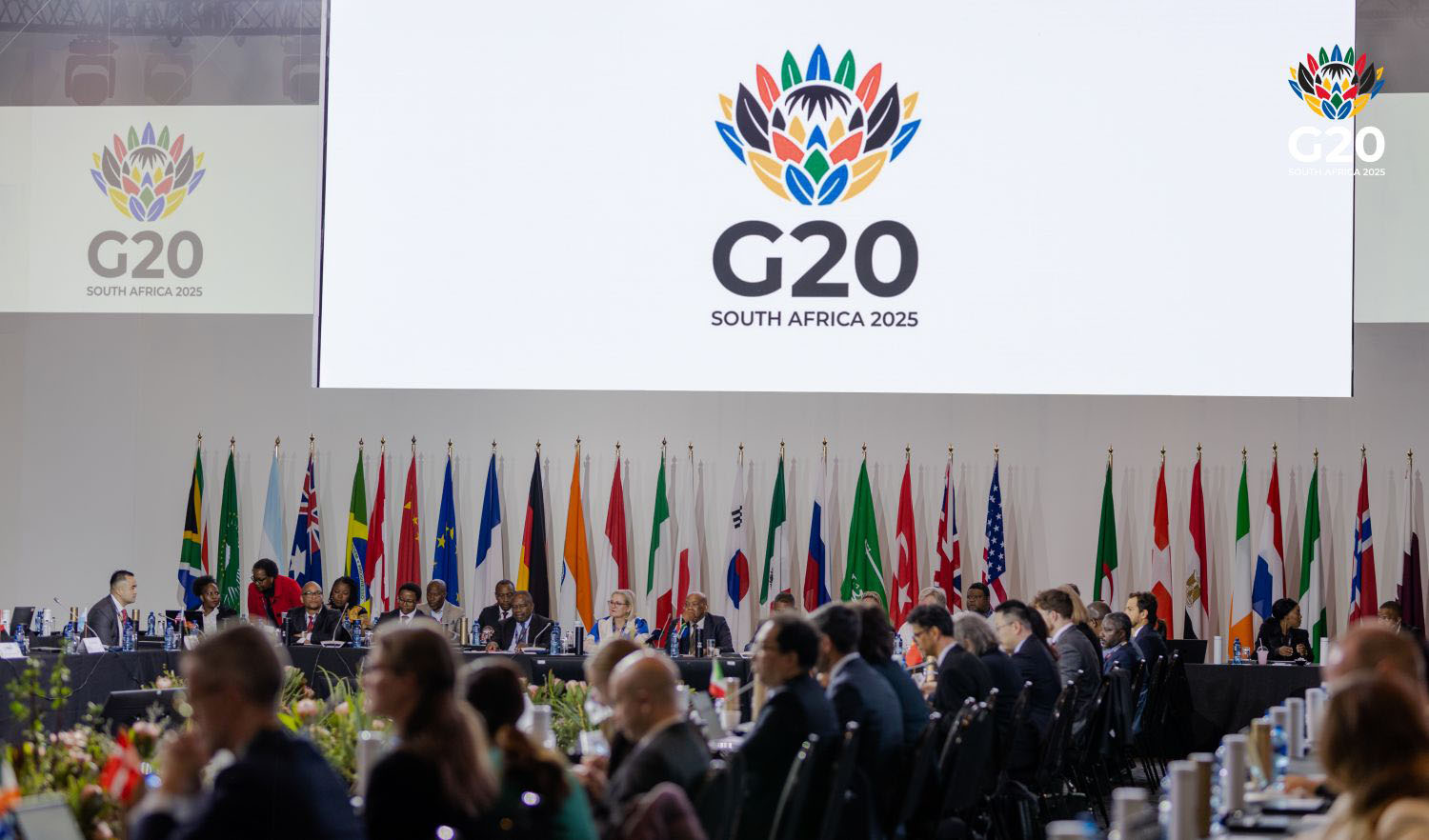
The recent G20 summit in Johannesburg was historic—it was the group’s first meeting in Africa and concluded its first rotation, with each G20 member country having now hosted a leaders-level summit. But this summit will also go down as notorious for being boycotted by the largest member. The G20 now begins round two amidst high uncertainty over its durability and utility as the United States takes the reins in 2026.
Present G20 pessimism partially stems from the Trump administration’s antipathy towards multilateralism, climate action, and development assistance. President Trump has already doubled down on his vendetta against South Africa, threatening to bar the country from the 2026 summit. This would be tragic—a pointless distraction that will sour the entire US host year. The move could also undermine US foreign policy interests by strengthening China’s pro-multilateralism persona vis-à-vis the Global South, especially as it hosts the Asia Pacific Economic Cooperation (APEC) forum in parallel.
The G20 has underlying problems too, with a lack of focus and an expansive footprint that diminishes potential impact. It has had the most success during crises and when it sticks to its original focus on economic and financial issues: the response to the Global Financial Crisis (which included the creation of the Financial Stability Board), the COVID debt initiatives, the Pandemic Fund, and the Joint Health-Finance Task Force. The group has also yielded key leaders-level political momentum—e.g., global minimum tax, increased ambition on climate mitigation, and multilateral development bank (MDB) reform.
The G20 has strayed well beyond these comparative advantages, though. It has grown into an expensive and bloated undertaking, with over 20 working groups, including on non-core issues (tourism and culture, to name a couple). Senior officials waste weeks negotiating minimally impactful communique text instead of having real conversations. Summit tables are so crowded with invited countries and international organizations that meetings lose the feel of informality and collegiality that made the G20 successful. And geopolitical conflicts, such as Russia’s war in Ukraine, have broken the G20 into blocs and dominated the attention of political leaders over global economic challenges.
Given the dynamic we saw in South Africa, expectations are reasonably low for next year’s G20. But if the United States can manage its own chaotic political impulses, 2026 could deliver significant and necessary rightsizing of the G20 to make it more effective in the future, and ideally deliver some specific policy wins along the way.
Back to basics
The United States is aiming to return the G20 to its “core mission of driving economic growth and prosperity to produce results.” The G20 is the only grouping that brings together the largest economies to address global economic and financial challenges at the political level, with a direct channel to the members’ leaders. Plus, with growing distrust of formal institutions, an informal grouping like the G20 may have more appeal. The G20 does not derive legitimacy from a set of written rules; rather the forum it provides for leaders and economic officials to freely converse. Progress is usually forged in the unofficial side meetings that appeal to personality-driven politics, rather than the formal G20 sessions.
While we have yet to see what the US ambition means in practice, it is right to focus on streamlining to make the G20 more impactful, including by enabling more informality and free-flowing dialogue. A first step would be eliminating the expectation of a lengthy communique in favor of a punchy deliverables list. This will shift the priority of senior officials from negotiating text to having unscripted and provocative conversations about key challenges. Plus, this will help clarify communications, so stated outcomes reflect actual progress made and not opaque recycled text.
Another significant step will be consolidating and eliminating working groups that are not focused on pressing global economic challenges. For 2026, this means centering most of the work in the “Finance Track,” led by the Treasury Department and Federal Reserve, with the leaders-level summit in Miami as a symbolic capstone. Enabling Treasury and the Fed to take the lead on substance would be a similar approach to the first Trump administration’s G7 in 2020. While the news cycle at the time focused on spats between G7 leaders over attendance to the eventually-cancelled summit, the G7 Finance Track held dozens of low-profile meetings to coordinate COVID economic responses and strategized to push through G20 debt initiatives.
Are policy wins possible?
The United States has articulated its policy priorities as: “unleashing economic prosperity by limiting regulatory burdens, unlocking affordable and secure energy supply chains, and pioneering new technologies and innovations.” The Finance Track will likely cover global external imbalances, given Treasury Secretary Scott Bessent’s focus on the topic; however, this will be a challenging conversation in light of US fiscal and trade policy. Beyond this, a meaningful, yet realistic, list of Finance Track deliverables could cover:
- Debt sustainability: While it is unlikely China will agree to reopen the Common Framework under US watch without significant concessions, the G20 could pursue specific improvements to debt transparency; press the IMF for genuinely realistic debt sustainability analyses; and lay a path for better debt contracts that give countries and creditors more flexibility, especially in times of crisis.
- Energy abundance: The rest of the G20 is unlikely to endorse the US administration’s push to make the MDBs agnostic to climate impact of energy investments. The G20 can still use the year to raise the ambition and coordinate the MDBs in how they support nuclear energy and critical minerals projects.
- Private capital mobilization: Efforts could leverage the MDB’s own risk-return data to press for (1) greater risk-taking in MDB private sector investments, including strategic use of concessional resources, and (2) evidence-based regulation of institutional investors and insurance companies.
- Digital payments: The G20 could refresh its work on digital payments in light of recent developments in stablecoin regulation, expanding technical assistance for developing countries.
Ideally the G20 would also retain the “Sherpa Track” (or political track) working groups that have a global economic overlay, such as those related to health, especially pandemic preparedness; climate; and food security. In a revamped version of these working groups, the focus would be on financing these global challenges and implications for the trading system. But it is highly unlikely the Trump administration will do so, given its well-known views on these matters. Other G20 members will need to grapple with how to keep up meaningful work that the United States eschews. That includes finding a permanent home for the Joint Health-Finance Task Force and teeing up long-overdue work to make the climate vertical funds more impactful.
After the United States cuts the G20 to the bare bones—either intentionally or because of self-imposed chaos—the UK presidency in 2027 will be an opportunity to strategically rethink how the G20 should be restructured. This should not mean bringing back all of the existing, largely ineffective workstreams. Instead, it should mean establishing a new structure that accentuates what has made the G20 impactful at times—the informality, a tight focus on global economic challenges, and a short list of issues where leaders can focus their energy.