
February 12, 2015
CGD is launching a new initiative on education reform in the developing world, involving some of the most exciting researchers in the field. We're tentatively calling it “Research on Improving Systems of Education,” aka RISE (get it?). New website and more details coming soon. In the meantime, here’s the first in a periodic series of education-related links that are worth checking out. Thanks to Amanda Beatty and Lee Crawfurd for helping curate the list.
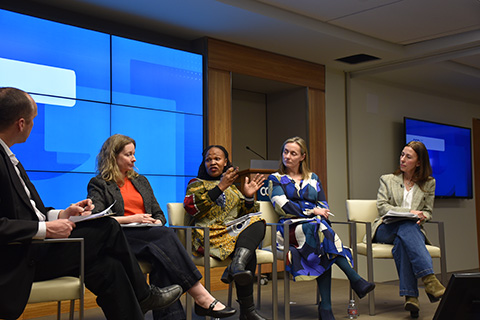
- “Citizen Led Assessment.” On Wed (Feb 11) CGD hosted Sarah Ruto, who directs a nine-country, NGO-led movement to measure learning progress among all children — both in school and out of school — in India and Pakistan (where the program is known as "ASER"), Kenya, Tanzania, and Uganda (Uwezo), Mali (Beekungo), Senegal (Jangandoo), and Mexico (MIA). See also this new op-ed in the Hindustan Times by ASER director Rukmini Banerjee on the case for community involvement in learning measurement: “Help every child learn, don’t leave education only to educationalists.”
-
“Great Teachers,” a new book by Barbara Bruns and Javier Luque at the World Bank discusses how to raise student learning in Latin America and the Caribbean. Beyond a simple literature review or summary of “best practices,” the book is refreshingly data heavy. It draws on a huge effort to collect information on what teachers do in the classroom, and link it to improvements in test scores.

- The political economy of evidence-based policy in India: Part 1, Duflo and Banerjee. A wide-ranging interview with the two rock-star economists by the Indian Express. The headline is “Learning’s not about enrollment. We’re failing children on a massive scale.”
- The political economy of evidence-based policy in India: Part 2, Muralidharan and Basu. UCSD's Karthik Muralidharan, who has been running massive experiments in education and social services in India, interviews World Bank Chief Economist, and former Chief Economic Adviser to India's Prime Minister, Kaushik Basu. My favorite line: “The economists have lost the battle” on social policy in India, with the Right to Education Act cited as exhibit A. “The general sense among a lot of economists is that these are extremely well intentioned but relatively poorly designed in terms of the first principles of economics.”
-
Measuring access to learning over a period of increased access to schooling. A new paper by Stephen Taylor and Nicholas Spaull of Stellenbosch University on the track record in Southern and East Africa since 2000. As you can see in the graph, there has been progress, but it has been painfully slow. And in the median country, only around two-thirds of kids in 6th grade are functionally literate. [Ungated]


- Slow down, you’re going too fast: Matching curricula to student skill levels. That's the title of a newly published paper by CGD's own Lant Pritchett and Amanda Beatty. They show that curricula in several developing countries are targeted far above the actual learning levels of most pupils, and that this gap can go a long way toward explaining why most children learn so little as they progress through primary school. [Ungated]
- For our wonkier readers interested in research methods: a new review of “value-added modeling” and how it can be used or misused to measure teacher quality based on test scores. This is an interesting case where ideological debates tend to line up around econometric methods.
- For a more skeptical take on VAMs, see this post from the oh-so-cleverly titled blog VAMboozled.
Topics
DISCLAIMER & PERMISSIONS
CGD's publications reflect the views of the authors, drawing on prior research and experience in their areas of expertise. CGD is a nonpartisan, independent organization and does not take institutional positions. You may use and disseminate CGD's publications under these conditions.