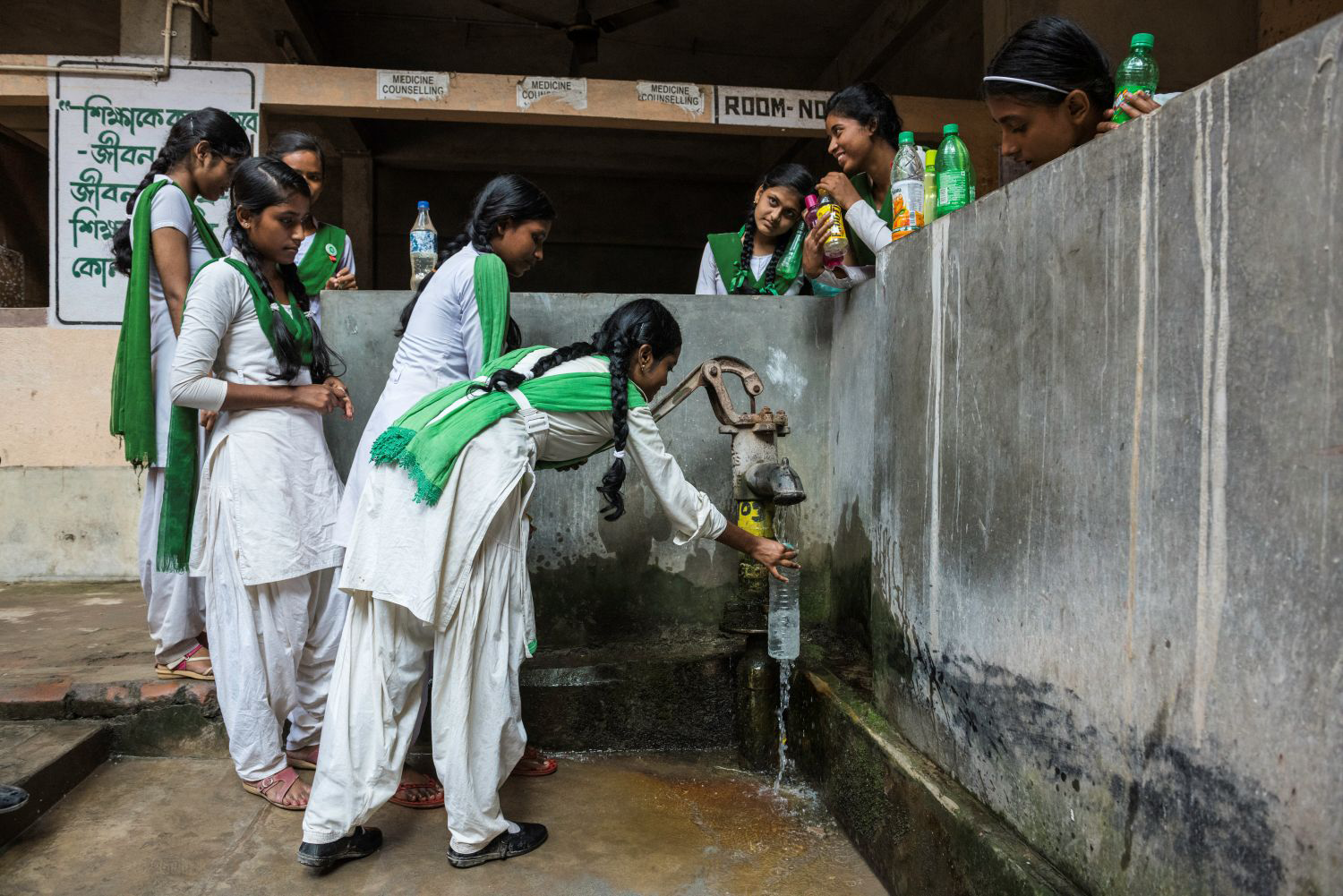
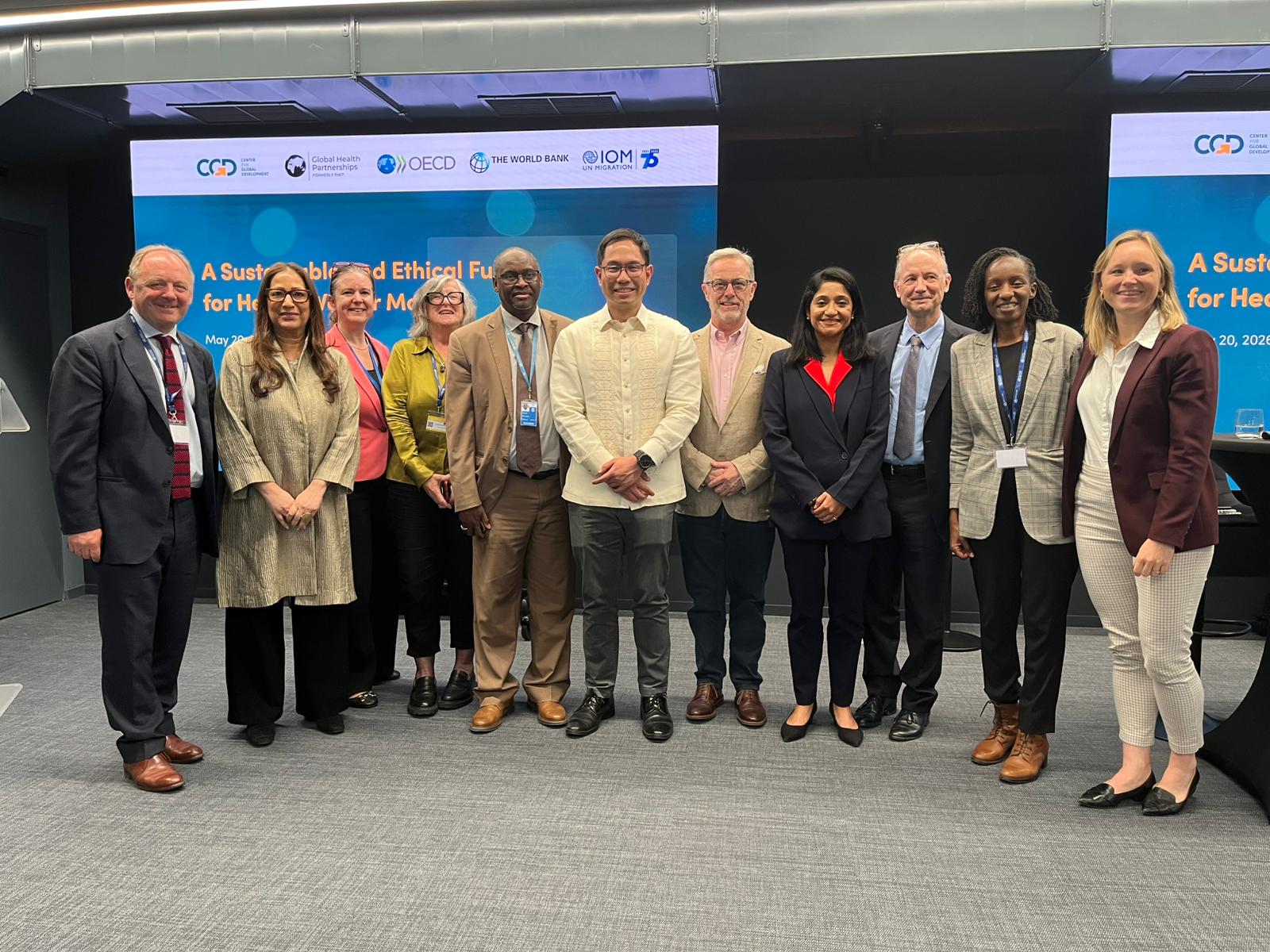
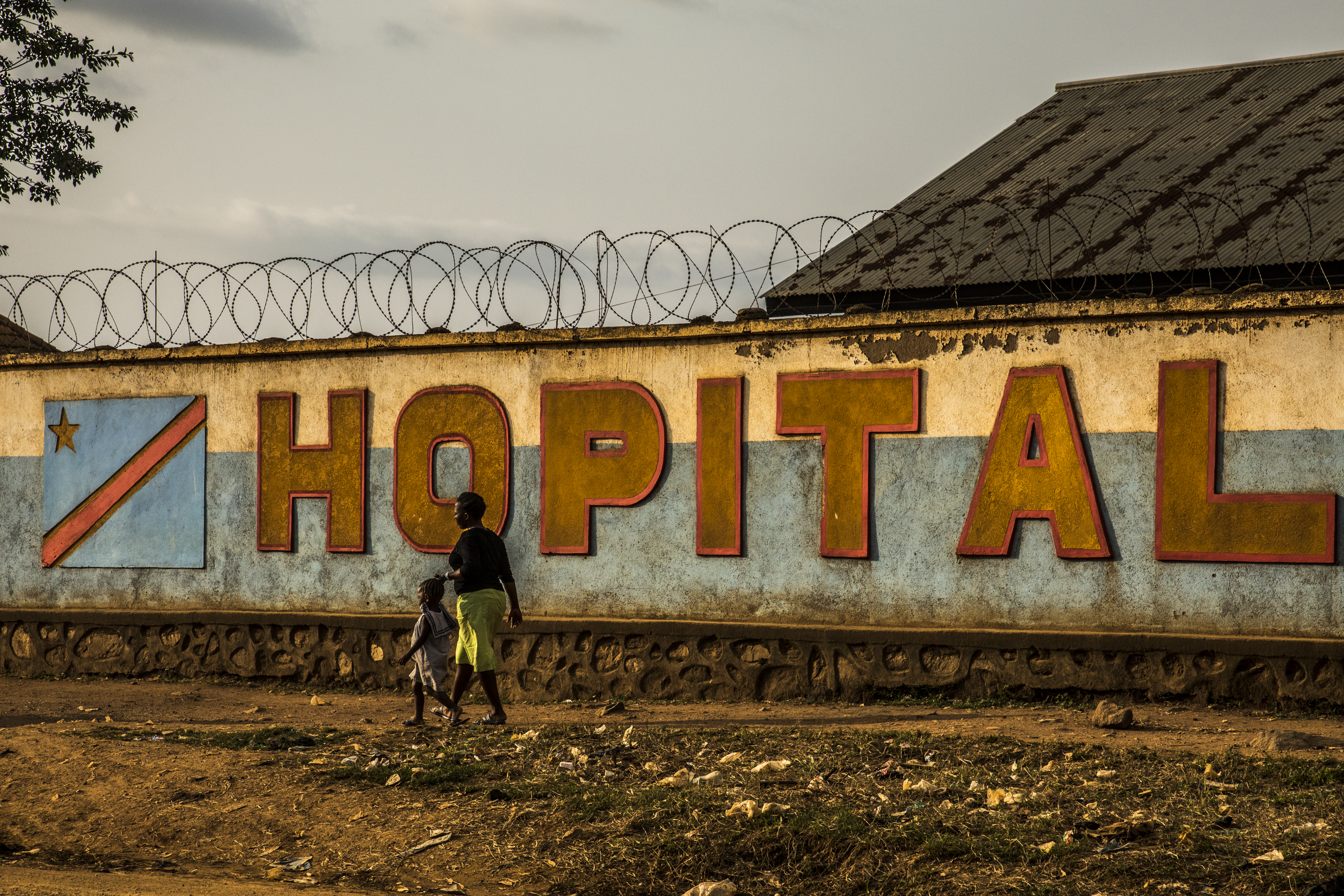
CGD's work on global health aims to improve the effectiveness of policies and actions of donors (bilateral aid agencies, philanthropic foundations, and multilateral organizations) and to enhance the coordination between these public agents and the private sector. CGD selects challenging and timely topics that demand the attention of global decision-makers faced with complex epidemiological, institutional, and economic choices. Health systems and financing, HIV/AIDS, health product innovation, chronic disease burden, and access to prevention, treatment and care services are among the topics that we address. In many cases, we work with academic, policy, and implementation experts convened in our CGD Working Groups to produce practical solutions that are innovative, viable, and technically sound.
Our work has contributed to significant improvements in policy. Millions Saved: Proven Successes in Global Health, now in its second edition, identifies large-scale, sustained health interventions and the common elements of their success; it has become required reading in global health classes in the United States and internationally. Our work on an Advanced Market Commitment (AMC) for vaccines sparked a $1.5 billion pilot program for to an improved vaccine to prevent pneumococcal disease, which annually kills about 1 million children in poor countries. The report of our Evaluation Gap Working Group led to the creation of the International Initiative on Impact Evaluation (3IE), a new independent body that is working to address the chronic lack of sound empirical studies about how well social development programs work across a range of settings.
The Private Sector Advisory Facility Working Group recommends a practical way for donors and technical agencies to support successful public-private interactions to strenghthen health systems in developing countries.
In a pathbreaking follow-up to the 2008 report Girls Count, Miriam Temin and CGD vice president Ruth Levine shed light on the reality of girls’ health worldwide and its enormous on the wellbeing and productivity of girls, their families, and their nations. Start with a Girl: A New Agenda for Global Health highlights successful efforts to break the cycle of ill health and proposes a comprehensive, practical health agenda that starts with adolescent girls.
In this working paper, commissioned as part of CGD's Drug Resistance Working Group, Prashant Yadav analyzes how changes in supply-chain business practices could help fix the misaligned incentives that hinder worldwide access to high-quality medical goods.
Before a 2006 UN Special Session proclaimed there should be universal access to antiretrovirals (ARV), the life-saving drugs were far too expensive for most people with AIDS. In a new CGD working paper, Ethan Kapstein and Josh Busby examine how activists transformed ARVs from expensive private goods into so-called merit goods—products that society agrees should be accessible to all. In a related blog post they discuss the implications of their analysis for AIDS and other global challenges.
READ THE BLOG | GO STRAIGHT TO THE WORKING PAPER
Few people doubt that gender inequality influences the spread of HIV/AIDS, yet public health efforts tend to focus on changing individual behavior rather than addressing structural factors—social, economic, physical and political—that influence the spread and effects of HIV and AIDS. This brief shows how three of the biggest donors to global HIV/AIDS programs can go beyond their stated commitments to address gender inequality and more effectively combat HIV and AIDS.
Undernutrition kills more than three million mothers and children annually, and millions more children suffer irreversible, long-term damage to their bodies and minds. Yet nutrition is too often a low priority for rich-world donors and even for governments in the most affected countries. A new CGD essay by Ruth Levine and Danielle Kuczynski shows why and offers two practical suggestions for improvement.
READ THE ESSAY
Gender inequality drives the HIV epidemic, increasing the burden on women and girls and undermining the global response to the disease. A new HIV/AIDS Monitor report finds that despite well-meaning language and admirable broad goals, three of the biggest HIV/AIDS funders have yet to translate their concern for women and girls into systematic, effective programming. The report shows how to make that happen.
Learn more
Donor spending on global health has surged, yet for many poor people in developing countries even basic prevention and treatment remain elusive. CGD’s newest book, Performance Incentives for Global Health: Potential and Pitfalls, shows how modest payments in cash or kind can get more health from health care spending. Informed by case studies and the Working Group on Performance-Based Incentives, co-authors Rena Eichler and CGD vice president Ruth Levine tell how to design and implement effective incentive programs—and what to avoid. Eichler and Levine offer a quick overview in a Q&A.
Learn more
This dataset compiles selected global variables on AIDS and its treatment and prevention. The data are in the format developed by the Stata statistical software corporation and are intended for use with Over and McCarthy's AIDSCost package for the purpose of projecting the future budgetary cost of scaling up AIDS treatment.
CGD senior fellow Mead Over and Owen McCarthy offer a users' manual and Stata software to help students and instructors of public health, development economics, or health economics to project the future budgetary cost of AIDS treatment in poor countries and to explore the many factors affecting the calculation.
In a pathbreaking follow-up to the 2008 report Girls Count, Miriam Temin and CGD vice president Ruth Levine shed light on the reality of girls’ health worldwide and its enormous on the wellbeing and productivity of girls, their families, and their nations. Start with a Girl: A New Agenda for Global Health highlights successful efforts to break the cycle of ill health and proposes a comprehensive, practical health agenda that starts with adolescent girls.
Donor spending on global health has surged, yet for many poor people in developing countries even basic prevention and treatment remain elusive. CGD’s newest book, Performance Incentives for Global Health: Potential and Pitfalls, shows how modest payments in cash or kind can get more health from health care spending. Informed by case studies and the Working Group on Performance-Based Incentives, co-authors Rena Eichler and CGD vice president Ruth Levine tell how to design and implement effective incentive programs—and what to avoid. Eichler and Levine offer a quick overview in a Q&A.
Learn more
Donor funding for HIV/AIDS has skyrocketed in the last decade: from US$ 300 million in 1996 to US$ 8.9 billion in 2006. Yet, surprisingly little is known about how this money is spent. Following the Funding for HIV/AIDS, by CGD's HIV/AIDS Monitor team, analyzes the policies and practices of the world's largest AIDS donors—the U.S. President's Emergency Plan for AIDS Relief (PEPFAR), the Global Fund to Fight AIDS, Tuberculosis and Malaria, and the World Bank's Multi-Country HIV/AIDS Program for Africa (MAP)—as they are applied in three case study countries: Mozambique, Uganda and Zambia. The report urges all three funders to improve country-level coordination, tracking of funds, and the collection and disclosure of data. It also identifies the strengths and shortcomings of each of the funders and offers suggestions for improvement.
Learn More
Millions Saved: Proven Success in Global Health is about part of that success story: 17 cases in which large-scale efforts to improve health in developing countries have succeeded - saving millions of lives and preserving the livelihoods and social fabric of entire communities.
The President's Emergency Plan for AIDS Relief (PEPFAR) is the single largest funder of global AIDS relief programs, but it does not regularly release data on how its money is spent. In this report, CGD's HIV/AIDS Monitor Team analyzes a newly available dataset of PEPFAR funding. They find, among other things, that only 30% of funds in 15 focus countries have gone to local organizations. They urge PEPFAR to regularly publish such funding data to improve transparency and strengthen coordination with host country governments and other stakeholders, and they suggest actions PEPFAR should take to improve the effectiveness and sustainability of its programs.
Learn More
Donors spend billions of dollars to fight HIV/AIDS in developing countries, but poor integration between donors and host country health systems risks undermining international efforts to prevent and treat AIDS. In this analysis, CGD’s HIV/AIDS Monitor argues that donors need to pay more attention to their overall effect on health systems, finding that the big international donors often create duplicate AIDS-specific systems that competitively draw on the health resources of developing countries. The report recommends taking specific steps to more broadly improve health information systems, improve supply chain systems, and strengthen the health workforce.
U.S. global AIDS spending is helping to prolong the lives of more than a million people, yet this success contains the seeds of a future crisis. Escalating treatment costs coupled with neglected prevention measures mean that AIDS spending is growing so rapidly that it threatens to squeeze out U.S. spending on other global health needs, even to the point of consuming half of the entire U.S. foreign assistance budget by 2016. Mead Over argues that AIDS treatment spending could quickly become a global entitlement since withdrawing funding for life-saving drugs would mean death for the beneficiaries. He offers suggestions for avoiding a ballooning AIDS treatment entitlement, including greatly stepped-up prevention efforts.
Learn More
The Private Sector Advisory Facility Working Group recommends a practical way for donors and technical agencies to support successful public-private interactions to strenghthen health systems in developing countries.
Gender inequality drives the HIV epidemic, increasing the burden on women and girls and undermining the global response to the disease. A new HIV/AIDS Monitor report finds that despite well-meaning language and admirable broad goals, three of the biggest HIV/AIDS funders have yet to translate their concern for women and girls into systematic, effective programming. The report shows how to make that happen.
Learn more
This report of the CGD working group on IMF Programs and Health Spending explores the controversy that surrounds IMF-supported programs in low-income countries and their effect on the health sector. Critics contend that programs unduly constrain health spending though macroeconomic, especially fiscal, policies that are too restrictive towards government spending and wage bill ceilings preventing a scaling up of the health workforce. The working group, chaired by CGD visiting fellow David Goldsbrough, examined the evidence through detailed case studies and cross-country data to make recommendations for the IMF and other relevant actors. They urge the IMF to explore a broader range of options on the fiscal deficit and government spending; clarify the role of the IMF with regards to aid projections; constrain the use of wage bill ceilings to very specific circumstances; and give greater emphasis to the smoothing of expenditures.
Thomas J. Bollyky is a visiting fellow at the Center for Global Development where he investigates the legal and ethical issues that arise during the discovery, development, and delivery of essential medical technologies to the developing world.
Research Fellow Michael Clemens leads CGD’s Migration and Development initiative. This work investigates how rich countries’ regulation of international movement by people from poor countries shapes the lives of the people who move as well as those who do not.
Ruth Levine, Vice President for Programs and Operations, and Senior Fellow
Ruth Levine is an internationally recognized expert on global health and health policy. She is a health economist with more than 15 years of experience designing and assessing the effects of social sector programs in Latin America, Eastern Africa, the Middle East, and South Asia. In addition to serving as CGD's vice president for programs and operations, she leads the Center's work on global health policy, including chairing a series of working groups on key policy and finance constraints to the effective use of donor funding for health programs in low-income countries.
Nandini Oomman, Director, HIV/AIDS Monitor, and Senior Program Associate
Nandini Oomman joined CGD in March 2006 as the director of the HIV/AIDS Monitor, which tracks the effectiveness of the three main aid responses to the epidemic: the Global Fund, the HIV/AIDS programs of the World Bank, and the U.S. President's Emergency Plan For AIDS Relief (PEPFAR).
Mead Over applies economics and statistics in the search for more effective, efficient, and pro-poor health policies in developing countries. Among other topics, he is currently searching for paths the world might take towards a future in which AIDS will no longer be an important part of either the disease burden or the financial burden of any country.

Bill Savedoff has been working for more than 20 years on economic and social development issues. His work is focused on finding ways to improve the quality of social services in developing countries, with particular attention to incentives, institutions, and political-economy.
Jeremy Shiffman is an Associate Professor of Public Administration at the Maxwell School of Citizenship and Public Affairs, Syracuse University. His research concerns the global and national political dynamics of health and population policy-making in poor countries. Jeremy has a particular interest in health policy agenda-setting: why political leaders prioritize some health issues and neglect others.

The Private Sector Advisory Facility Working Group recommends a practical way for donors and technical agencies to support successful public-private interactions to strenghthen health systems in developing countries.
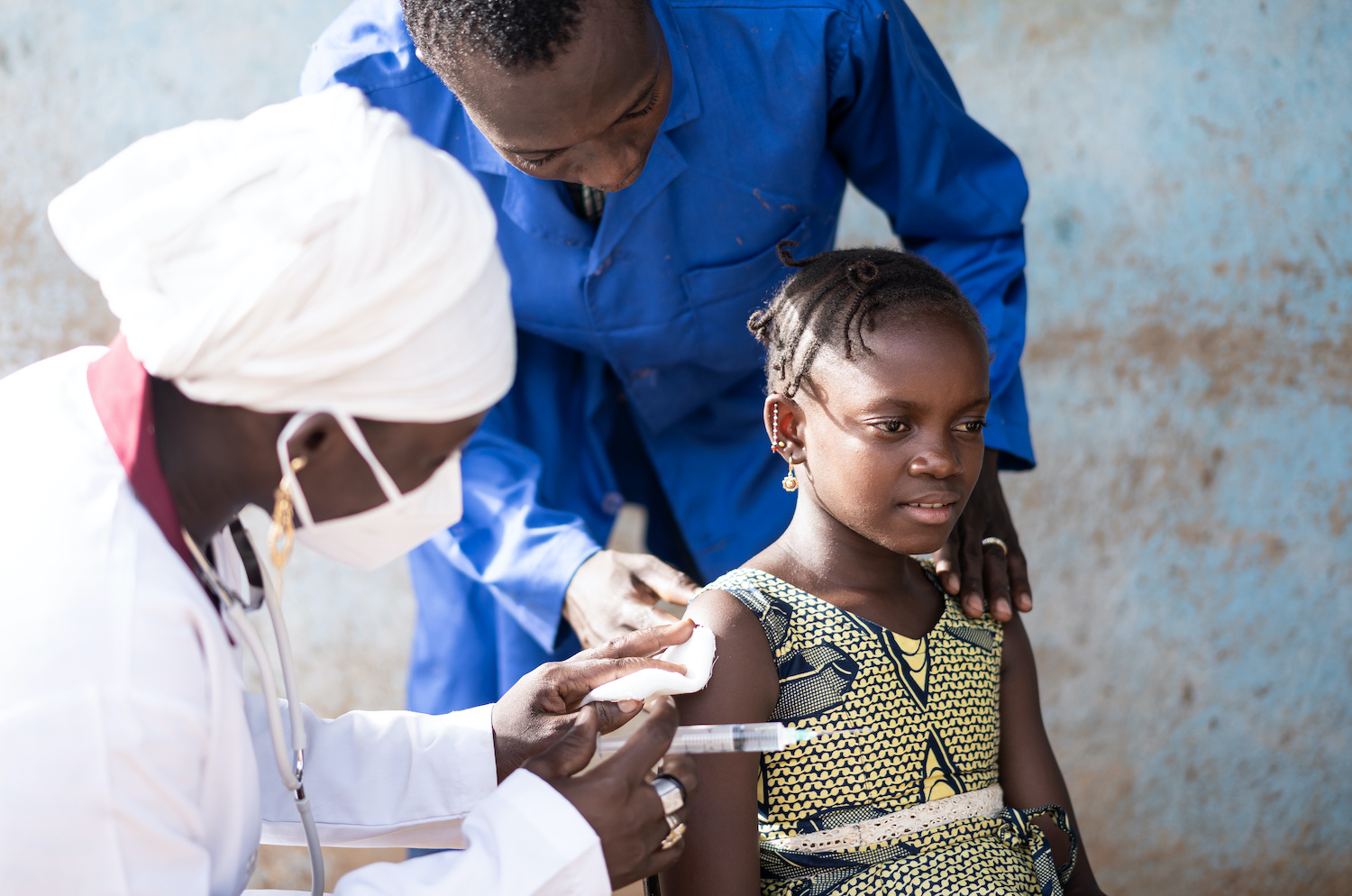
In a pathbreaking follow-up to the 2008 report Girls Count, Miriam Temin and CGD vice president Ruth Levine shed light on the reality of girls’ health worldwide and its enormous on the wellbeing and productivity of girls, their families, and their nations. Start with a Girl: A New Agenda for Global Health highlights successful efforts to break the cycle of ill health and proposes a comprehensive, practical health agenda that starts with adolescent girls.
In this working paper, commissioned as part of CGD's Drug Resistance Working Group, Prashant Yadav analyzes how changes in supply-chain business practices could help fix the misaligned incentives that hinder worldwide access to high-quality medical goods.
Before a 2006 UN Special Session proclaimed there should be universal access to antiretrovirals (ARV), the life-saving drugs were far too expensive for most people with AIDS. In a new CGD working paper, Ethan Kapstein and Josh Busby examine how activists transformed ARVs from expensive private goods into so-called merit goods—products that society agrees should be accessible to all. In a related blog post they discuss the implications of their analysis for AIDS and other global challenges.
READ THE BLOG | GO STRAIGHT TO THE WORKING PAPER
Few people doubt that gender inequality influences the spread of HIV/AIDS, yet public health efforts tend to focus on changing individual behavior rather than addressing structural factors—social, economic, physical and political—that influence the spread and effects of HIV and AIDS. This brief shows how three of the biggest donors to global HIV/AIDS programs can go beyond their stated commitments to address gender inequality and more effectively combat HIV and AIDS.
Undernutrition kills more than three million mothers and children annually, and millions more children suffer irreversible, long-term damage to their bodies and minds. Yet nutrition is too often a low priority for rich-world donors and even for governments in the most affected countries. A new CGD essay by Ruth Levine and Danielle Kuczynski shows why and offers two practical suggestions for improvement.

READ THE ESSAY
Gender inequality drives the HIV epidemic, increasing the burden on women and girls and undermining the global response to the disease. A new HIV/AIDS Monitor report finds that despite well-meaning language and admirable broad goals, three of the biggest HIV/AIDS funders have yet to translate their concern for women and girls into systematic, effective programming. The report shows how to make that happen.
Learn more
Donor spending on global health has surged, yet for many poor people in developing countries even basic prevention and treatment remain elusive. CGD’s newest book, Performance Incentives for Global Health: Potential and Pitfalls, shows how modest payments in cash or kind can get more health from health care spending. Informed by case studies and the Working Group on Performance-Based Incentives, co-authors Rena Eichler and CGD vice president Ruth Levine tell how to design and implement effective incentive programs—and what to avoid. Eichler and Levine offer a quick overview in a Q&A.
Learn more
This dataset compiles selected global variables on AIDS and its treatment and prevention. The data are in the format developed by the Stata statistical software corporation and are intended for use with Over and McCarthy's AIDSCost package for the purpose of projecting the future budgetary cost of scaling up AIDS treatment.
CGD senior fellow Mead Over and Owen McCarthy offer a users' manual and Stata software to help students and instructors of public health, development economics, or health economics to project the future budgetary cost of AIDS treatment in poor countries and to explore the many factors affecting the calculation.